Some jazz did show up at the Air jamaica Jazz and Blues festival on Saturday night. The New Stylistics
wowed the crowd, but my pick for the night remains Earth Wind & Fire
Strings, swing and the 70s Air Jamaica Jazz & Blues review
MICHAEL A EDWARDS
IN putting Saturday night’s superlative closing presentation at the Rose Hall aqueduct into context, we have to the late former prime minister Michael Manley. Floridabased group Strings set a mellow tone to be gin; jazz showed up, bouncy, unassuming yet unapologetic, in the person of Monty Alexander and a wisely chosen crew of special guests; said jazz embraced reggae, with no compromise or dilution on the part of either; and a pair of soul supergroups that blossomed in the 1970s, gave a lesson the musical spirit of that era, a lesson not lost on latterday soul journeyman Anthony Hamilton, who appeared in between.
In short, the word on Saturday night was love.
In the generally narrow band of music appreciation that prevails among Jamaicans, Earth Wind and Fire means Reasons and little else. The hordes who streamed into the front of stage area - and clogged the space with their folding chairs (more on that later) were expecting the group to deliver their landmark hit
immediately and for the love-fest to begin - but Phillip Bailey, Verdeen White and company flipped the script.
With the volume levels turned up - way up - the band launched a blistering funk attack that proved severe enough to drive many of the uncommitted away from proximity to the speakers.
The remaining faithful, and the rest of the large audience, were eventually rewarded with the prized tune, part of a suite of ballads that also included In My Heart Tonight and After The Love Is Gone. Thereafter, its was ‘hitsville’ a potpourri of some of their biggest numbers, including Let’s Groove, Got To Get You Into My Life, Devotion and September. The band members exited the stage at this point, prompting some to believe the show was over, but the faithful new better. When they returned and struck up the opening bars of That’s The Way Of The World, one got a sensation of satisfaction very much akin to completing a superlative meal at a five-star restaurant.
Russell Thompkins and the New Stylistics earlier offered their own musical buffet, one liberally sprinkled with the love ballads, slick dance moves and tight harmonies that made the original group radio staples. Sharp, seasoned and exuding soulster cool in their neatly tailored powder blue suits, the Stylistics made the Aqueduct into an oasis of good taste, decency and sensitivity.
He may have lacked the sartorial eloquence, but American southerner Anthony Hamilton showed respect for his hosts, as he and his two backup singers were decked out in ‘Jamaica’ T-shirts. Even at the start of his set, there were questions of “Who dis guy?” But if Hamilton came to the MoBay stage a stranger, he certainly left it as a friend, if not a brother. His humility, honesty and genuine affinity for the music came through on selections such as Where I’m From, Charlene, Better Days and Sista Big
Bones, the later a wry compliment to ‘full-figured’ women.
In his umpteenth appearance at the jazzfest, piano man Monty Alexander began with a venture into dub, before retracing his musical journey from Jamaica to the US and around the world.
He got sterling assistance from Freddy Cole (brother to Nat), who sparkled on Route 66 and Straighten Up And Fly Right, from New Orleans native Herlin Riley (an alumnus of trumpeter Wynton Marsalis’ small groups as well as the Jazz @ Lincoln Centre orchestra) on drums; frequent Alexander collaborator, bassist Hassan Shakur and tenor saxophone statesmen Red Holloway and Houston Person. Tony Rebel and Dean Fraser also chipped in to good effect. They set feet a dancing, even as the heavens opened - just briefly- for a moderate shower.
Tuesday, January 30, 2007


Monday, January 22, 2007
Another one-two punch form the Grim Reaper
Was so busy recapping Barbados jazz last week, neglected to mention the sadness of losing two important jazz figures in same day. They may be gone physically, but the musical legacy cannot be erased or spoiled

Another one-two punch form the Grim Reaper
Was so busy recapping Barbados jazz last week, neglected to mention the sadness of losing two important jazz figures in same day. They may be gone physically, but the musical legacy cannot be erased or spoiled
Sunday, January 21, 2007
looking back, looking ahead
Now Is The Time: Looking back,
Jazz First.
BY Michael 'Jazzofonik' Edwards
Sunday, January 21, 2007
The Roman deity Janus whose name was co-opted for the first month in our calendar year, was visually represented as a two-headed man, the heads glancing in opposite directions - one back, one forward.
Goapele
Mythology aside, the analogy seems entirely appropriate, with one music festival (Barbados Jazz) behind, and another (Air Jamaica Jazz and Blues) immediately upon us.
In keeping with the theme, the recap of the Barbados Jazz Festival will be done in reverse. Beginning with the climatic Sunday evening at Farley Hill national park, which unreservedly joins St Lucia's Pigeon Point as one of the region's most attractive jazz venues (we've seen pictures of the new Air Jamaica Jazz venue in preparation, and indications are certainly very favourable, but we'll reserve final judgement until next week).
In a few hours time, the Air Jamaica Jazz & Blues Festival gets underway. This year's version features both an expanded main festival venue, the Rose Hall Aqueduct ground, and an expansion in the number of venues, with shows also slated for Mobay's Half Moon hotel (trumpeter Chuck Mangione and vibist Roy Ayers) as well as the Gardens of the Pegasus in Kingston, which takes the spotlight tonight.
The venue, already known to live music lovers as the home of the Jazz In The Gardens series, will this time host Cuban pop-salsa-funksters Yerba Buena, musical 'oracle' (my term) Marjorie Whylie and her Whylie Whrythms combo and guitarist Maurice Gordon, who can do just about anything he wishes on the instrument.
Over at Rose Hall, the festival gets underway in earnest on its now customary Thursday, with acts drawn from a smorgsbord representing pop, soul and reggae. Yes, the assertion holds true that there's hardly any jazz or blues represented in the Thursday-Sunday run of the event (with the obvious apologies to piano legend, Monty Alexander).
Sure, the hordes of persons heading to Montego Bay will enjoy Earth, Wind & Fire, Michael Bolton, Christopher Cross and the return of Kenny Rogers, but perhaps now with some financial success, festival director Walter Elmore may next year look more sincerely into the vast ocean of both emerging and established jazz/blues acts and scoop out more worthy acts to give the Jazz and Blues name the credibility it deserves.
Jazz First.
BY Michael 'Jazzofonik' Edwards
Sunday, January 21, 2007
The Roman deity Janus whose name was co-opted for the first month in our calendar year, was visually represented as a two-headed man, the heads glancing in opposite directions - one back, one forward.
Goapele
Mythology aside, the analogy seems entirely appropriate, with one music festival (Barbados Jazz) behind, and another (Air Jamaica Jazz and Blues) immediately upon us.
In keeping with the theme, the recap of the Barbados Jazz Festival will be done in reverse. Beginning with the climatic Sunday evening at Farley Hill national park, which unreservedly joins St Lucia's Pigeon Point as one of the region's most attractive jazz venues (we've seen pictures of the new Air Jamaica Jazz venue in preparation, and indications are certainly very favourable, but we'll reserve final judgement until next week).
In a few hours time, the Air Jamaica Jazz & Blues Festival gets underway. This year's version features both an expanded main festival venue, the Rose Hall Aqueduct ground, and an expansion in the number of venues, with shows also slated for Mobay's Half Moon hotel (trumpeter Chuck Mangione and vibist Roy Ayers) as well as the Gardens of the Pegasus in Kingston, which takes the spotlight tonight.
The venue, already known to live music lovers as the home of the Jazz In The Gardens series, will this time host Cuban pop-salsa-funksters Yerba Buena, musical 'oracle' (my term) Marjorie Whylie and her Whylie Whrythms combo and guitarist Maurice Gordon, who can do just about anything he wishes on the instrument.
Over at Rose Hall, the festival gets underway in earnest on its now customary Thursday, with acts drawn from a smorgsbord representing pop, soul and reggae. Yes, the assertion holds true that there's hardly any jazz or blues represented in the Thursday-Sunday run of the event (with the obvious apologies to piano legend, Monty Alexander).
Sure, the hordes of persons heading to Montego Bay will enjoy Earth, Wind & Fire, Michael Bolton, Christopher Cross and the return of Kenny Rogers, but perhaps now with some financial success, festival director Walter Elmore may next year look more sincerely into the vast ocean of both emerging and established jazz/blues acts and scoop out more worthy acts to give the Jazz and Blues name the credibility it deserves.
Friday, January 19, 2007
Hamilton
The Many Flavours of Anthony Hamilton for Air Jamaica Jazz and Blues
When the 2007 Air Jamaica Jazz and Blues Festival touches down in Montego Bay Monday, January 23 – Saturday, January 27, soulful singer Anthony Hamilton will make his second trip to Jamaica. His first time to the island, he came intent on soaking up the triple joys of sun, sand and sea. This time he comes to woo Jamaicans with his gritty, soulful and funky music.
A barber by trade, Anthony Hamilton is looking to cut away worry and expose patrons at the Jazz and Blues Festival to a great time. Soul is the space where the spiritual meets the secular and Hamilton captures that beautiful with a rich sound that speaks eloquently of spiritual hymns revealing his back ground in the church as well as fun-loving funky tracks like Sista Big Bones. Sista Big Bones, a tribute to women with curves is one of the most popular tracks on Hamilton’s current album Ain’t Nobody Worryin.
Hamilton points out that the track is a particular favourite of women with curves. “All the women are like, “ ‘We’re so glad that you made a song about us,’” he says. Born in Charlotte, North Carolina, Mr. Hamilton explains that he grew up with an appreciation for more than skin and bones. “I’m a southern boy,” he says, “and growing up I see those are the women who got it going on.” Revealing a sly sense of humour, Mr. Hamilton explains that the serving of “extra meat” often comes with a side order of “extra personality”.
Ain’t Nobody Worryin has many moods and methods. The album travels from the soaring heights to the murky depths of love with all the joy and pain that is involved. It includes I Know What Love is About that feels like a hymn while Everybody is a very “Reggae-fied” track that will definitely ease Mr. Hamilton’s welcome with Jamaican audiences.
“I understand the spirit behind [Reggae],” Mr. Hamilton says, explaining that Bob Marley and Prince Malachi are among his musical influences. So, he points out that he was attracted to Everybody because it had the feel of authentic Reggae music rather than a “watered down” version.
The spirituality that comes out in is music is by no means accidental or a hold over from another life. Spirituality, he says, is very important to him. “I wouldn’t even be Anthony not doing that,” he says. “I love it, and that’s what I stand for.” Mr. Hamilton points out that he is very interested in the spirit and spirituality that guides traditional black music.
“It’s not just about getting a couple dollars and being with a couple girls in a video,” he says. With a laugh, Mr. Hamilton reveals yet another reason. “My grandmother would whip my butt,” he says. “She’d get up out of the grave and whip me. That’s part of why I do it. I don’t want a whipping.”
His reference to his grandmother’s hand in raising him hints at Mr. Hamilton’s commitment to his family. A father to three sons, Mr. Hamilton speaks of the incomparable joy of having his sons tell him they love him. “My father wasn’t around all along, so I wanted to give them that,” he says.
An understanding of the value of love and family comes through easily with Ain’t Nobody Worryin and Mr. Hamilton admits that a part of what he loves about making music is producing works that mean something to other people. So, not surprisingly, a part of what he is looking forward to at the Air Jamaica Jazz and Blues Festival is to see which songs strike a responsive chord in the Jamaican audience.
Mr. Hamilton reveals that he knows how vocal Jamaican audiences can be and so expects them to tell him what they like and don’t like. He is also hoping to get a bite out of Jamaican culture. Explaining that in New York he has consumed much Jamaican food but he is looking forward to chomping into the real flavour on home ground. And while he does so, Jamaicans can get a chance to savour his flavour.
When the 2007 Air Jamaica Jazz and Blues Festival touches down in Montego Bay Monday, January 23 – Saturday, January 27, soulful singer Anthony Hamilton will make his second trip to Jamaica. His first time to the island, he came intent on soaking up the triple joys of sun, sand and sea. This time he comes to woo Jamaicans with his gritty, soulful and funky music.
A barber by trade, Anthony Hamilton is looking to cut away worry and expose patrons at the Jazz and Blues Festival to a great time. Soul is the space where the spiritual meets the secular and Hamilton captures that beautiful with a rich sound that speaks eloquently of spiritual hymns revealing his back ground in the church as well as fun-loving funky tracks like Sista Big Bones. Sista Big Bones, a tribute to women with curves is one of the most popular tracks on Hamilton’s current album Ain’t Nobody Worryin.
Hamilton points out that the track is a particular favourite of women with curves. “All the women are like, “ ‘We’re so glad that you made a song about us,’” he says. Born in Charlotte, North Carolina, Mr. Hamilton explains that he grew up with an appreciation for more than skin and bones. “I’m a southern boy,” he says, “and growing up I see those are the women who got it going on.” Revealing a sly sense of humour, Mr. Hamilton explains that the serving of “extra meat” often comes with a side order of “extra personality”.
Ain’t Nobody Worryin has many moods and methods. The album travels from the soaring heights to the murky depths of love with all the joy and pain that is involved. It includes I Know What Love is About that feels like a hymn while Everybody is a very “Reggae-fied” track that will definitely ease Mr. Hamilton’s welcome with Jamaican audiences.
“I understand the spirit behind [Reggae],” Mr. Hamilton says, explaining that Bob Marley and Prince Malachi are among his musical influences. So, he points out that he was attracted to Everybody because it had the feel of authentic Reggae music rather than a “watered down” version.
The spirituality that comes out in is music is by no means accidental or a hold over from another life. Spirituality, he says, is very important to him. “I wouldn’t even be Anthony not doing that,” he says. “I love it, and that’s what I stand for.” Mr. Hamilton points out that he is very interested in the spirit and spirituality that guides traditional black music.
“It’s not just about getting a couple dollars and being with a couple girls in a video,” he says. With a laugh, Mr. Hamilton reveals yet another reason. “My grandmother would whip my butt,” he says. “She’d get up out of the grave and whip me. That’s part of why I do it. I don’t want a whipping.”
His reference to his grandmother’s hand in raising him hints at Mr. Hamilton’s commitment to his family. A father to three sons, Mr. Hamilton speaks of the incomparable joy of having his sons tell him they love him. “My father wasn’t around all along, so I wanted to give them that,” he says.
An understanding of the value of love and family comes through easily with Ain’t Nobody Worryin and Mr. Hamilton admits that a part of what he loves about making music is producing works that mean something to other people. So, not surprisingly, a part of what he is looking forward to at the Air Jamaica Jazz and Blues Festival is to see which songs strike a responsive chord in the Jamaican audience.
Mr. Hamilton reveals that he knows how vocal Jamaican audiences can be and so expects them to tell him what they like and don’t like. He is also hoping to get a bite out of Jamaican culture. Explaining that in New York he has consumed much Jamaican food but he is looking forward to chomping into the real flavour on home ground. And while he does so, Jamaicans can get a chance to savour his flavour.
Sunday, January 14, 2007
Stay tuned for Barbados report
Its been a diverse and even eventful week in Barbados
everything from the Blue not post-bop of terence Blanchard & Co.
to pan-jazz, Prince-inspired funk-gospel-pop (newcomer Hal Linton)
and some mind-blowing Lee Morganesque trumpet from a Cuban player
named Yasseq Manzano -who I will definitely will be checking out
in more detail.
Stay tuned for a fuller report and wrap-up in a few days
everything from the Blue not post-bop of terence Blanchard & Co.
to pan-jazz, Prince-inspired funk-gospel-pop (newcomer Hal Linton)
and some mind-blowing Lee Morganesque trumpet from a Cuban player
named Yasseq Manzano -who I will definitely will be checking out
in more detail.
Stay tuned for a fuller report and wrap-up in a few days
Wednesday, January 03, 2007
FOJazz ist meeting
The coinage is mine but it sounds better than Friends of Jazz
Friends of Jazz
FIRST MONTHLY MEETING
SUNDAY 7TH JANUARY 2007
4 - 7 P.M.
at
THE VERANDA
2 TRAFALGAR ROAD
SONNY BRADSHAW &
THE JAZZ MOBILE
MAIN SPEAKERS
* MARJORIE WHYLIE-Piano *JACKIE JACKSON-Bass
*DESI JONES-Drums * MAURICE GORDON-Guitar
*LEON DUNBAR-Clarinet
*SONNY BRADSHAW-Trumpet-Flugelhorn
OUIDA LEWIS – Percussion/Tap Dance
*DEAN FRASER-Saxophones
*MARY ISAACS-Guest Vocals
DJ JAZZ CD’s – Monte Blake, Harry Graham, Carl Percy, Keith Brown
Friends of Jazz
FIRST MONTHLY MEETING
SUNDAY 7TH JANUARY 2007
4 - 7 P.M.
at
THE VERANDA
2 TRAFALGAR ROAD
SONNY BRADSHAW &
THE JAZZ MOBILE
MAIN SPEAKERS
* MARJORIE WHYLIE-Piano *JACKIE JACKSON-Bass
*DESI JONES-Drums * MAURICE GORDON-Guitar
*LEON DUNBAR-Clarinet
*SONNY BRADSHAW-Trumpet-Flugelhorn
OUIDA LEWIS – Percussion/Tap Dance
*DEAN FRASER-Saxophones
*MARY ISAACS-Guest Vocals
DJ JAZZ CD’s – Monte Blake, Harry Graham, Carl Percy, Keith Brown
Friday, December 29, 2006
'Jubba' jams at the Quad
Drummer Deleon 'Jubba' White returns with a combo to Christopher's Jazz
lounge in the Quad come Tuesday, Jan 2, to resume the Tuesday Nite Live
series for 2007. The show begins at 7pm
This will be 'Jubba's ' third stint at the Christopher's since the series
started in August this year.
The series has been attracting a growing number of music
aficionados and White has proven among the more popular
featured acts.
lounge in the Quad come Tuesday, Jan 2, to resume the Tuesday Nite Live
series for 2007. The show begins at 7pm
This will be 'Jubba's ' third stint at the Christopher's since the series
started in August this year.
The series has been attracting a growing number of music
aficionados and White has proven among the more popular
featured acts.
'Jubba' jams at the Quad
Drummer Deleon 'Jubba' White returns with a combo to Christopher's Jazz
lounge in the Quad come Tuesday, Jan 2, to resume the Tuesday Nite Live
series for 2007. The show begins at 7pm
This will be 'Jubba's ' third stint at the Christopher's since the series
started in August this year.
The series has been attracting a growing number of music
aficionados and White has proven among the more popular
featured acts.
lounge in the Quad come Tuesday, Jan 2, to resume the Tuesday Nite Live
series for 2007. The show begins at 7pm
This will be 'Jubba's ' third stint at the Christopher's since the series
started in August this year.
The series has been attracting a growing number of music
aficionados and White has proven among the more popular
featured acts.
steveandcleveland2
Following on from the Tony Kofi discovery, I came across the website of UK bassist Steve lawson (left) jamming alongside Cleveland Watkiss. Anglo-jazz, with Afro-Caribbean input, is alive and well.

Tuesday, December 19, 2006
Tony Kofi DSC_0240a
Just heard him on radio a few nights ago (thanks again, Dermot Hussey) and now I come across this.

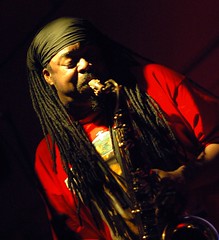
Courtney Pine DSC_0118ab
from (I asume) Brit Rchard kaby comes this great shot of Courtney Pine 'blowing up'
Monday, December 11, 2006
Seretse in Studio
Guitarist Seretse Small and his combo, Seretse and the True Democrats
have been work on a number of recording projects, one being a track
entitled Freedom.
Seretse and the True Democrats are also the featured act on the Tuesday
Nite live at Christopher's Jazz bar in the Quad complex New Kingston
beginning at 7:00 pm tomorrow night
have been work on a number of recording projects, one being a track
entitled Freedom.
Seretse and the True Democrats are also the featured act on the Tuesday
Nite live at Christopher's Jazz bar in the Quad complex New Kingston
beginning at 7:00 pm tomorrow night
Thursday, December 07, 2006
Fusion, jazzi nthe round and more
Jazz Notes
Fusion and the age-old question
BY MICHAEL ‘JAZZOFONIK’ EDWARDS
NOT that the initial lineup could justify the tag (with apologies to Monty Alexander), but the recent additions to the roster of the Air Jamaica Jazz & Blues Festival — particularly vibist Roy Ayers — have led this writer to reconsider the question of jazz fusion.
Some in fact consider the term to be an oxymoron since, as we have learnt in this column, jazz was, from its very earliest times, the product of several musical styles, reflective of the diverse ethnocultural influences that came to bear on its home city, New Orleans.
But in the contemporary sense, fusion concerns primarily the introduction of r&b, rock, funk, reggae and other styles to either bebop or classic swing structures.
Of course herein lies much of the problem, given our penchant for resorting to the clear order and inherent safety of classifications.
Over the last 40 years or so as recorded music aired on radio and other formats have become a greater influence on public taste than live performances, the swing and bebop (and hardbop) movements which dominated the genre in the first half of the 20th Century have increasingly been sidelined. This is not to say that they are no longer appreciated or even being played — far from it. But there’s no question that mainstream broadcast media programmers find these modes either unpalatable or at least less palatable (and thereby less profitable) than those which feature the more recognisable pop elements.
The emergence of the terms ‘smooth’, ‘light’, ‘easy listening’ and other similar palliatives — mostly if not exclusively the creations of radio programmers and owners, affirms this. Thus the impression is conveyed and enforced that the bop and swing styles represent “hard jazz”, a term implying that such music is too harsh to the ear. Indeed, many persons this writer has talked to have expressed that exact sentiment, even though the overwhelming majority of them have had little, if any, sustained exposure to so-called ‘hard jazz’.
The answer lies in exploiting the channels to provide this sustained exposure and beyond that, in creating new ones. Mention has already been made of the former Radio Mona, now News Talk 93, but even in its best periods, it was not, and now definitely is not, a jazz station. Jazz needs a home on radio (and at least on local cable TV, if not free-toair) in same way that endangered animal species need the designated habitats. Further, a walk through Half-Way-Tree or most urban communities will find a sound system (makeshift and illegal, yes) set up at several corners and other points blaring dancehall and roots reggae. I’m not advocating streetside jazz sounds (or maybe it mightn’t be a bad idea) but the music needs to be a part of the daily public experience, otherwise it will continue to be ignored and sidelined, instead of appreciated and renewed, regardless of what genre it is blended with.
Sonny Rollins said: “Jazz is the only music form that can absorb just about anything else and still be jazz.”
By keeping the music in the public arena, we can allow that philosophy to be tested, to our collective benefit.
Jazz is back in the Round
Got wind from the EMC’s Maurice Gordon about the renewal of jazz in the Round programme at the school.
Jazz in the Round 2K6 is the end of first semester concert and it takes place this coming Friday, December 8, 2006 beginning at 7:30 pm in the Round at the School of Music (right outside the auditorium. The featured performers will be Gordon’s second year Certificate and Diploma Jazz Improvisation students.
“This is a concert to showcase and examine the talent and efforts of all students involved in the study of jazz and improvisation at The School of Music/Edna Manley College,” he points out. The concert will feature several groups performing in Piano Trios or Quartets with the addition of singers and other instruments. Students will be evaluated by Gordon and a panel. They will be graded on their ability to swing, spontaneously create music, and to perform with some authenticity in the idioms studied.
Jazz Improvisation, as taught by jazz guitarist and lecturer Gordon at School of Music, involves the study of improvising over a variety of jazz styles and related music which is performed in the context of jazz. The students study the technique of improvisation and learn a common repertoire to help prepare them for the working world. Gordon uses various musical styles as a vehicle for improvisation, these include mento, reggae, blues, Jamaican Popular music and various jazz styles.
The public is being invited to come out and enjoy some good “food for the ear” for a generous donation, which will be used towards the purchase of equipment and books for the Jazz department.
Dress casual and bring something to sit on the beautiful, comfortable and well-manicured lawn of the Round of the School of Music.
The Edna Manley College is the centre of excellence in the arts and provides a physical and academic environment that epitomises the spirit of the arts.
Fusion and the age-old question
BY MICHAEL ‘JAZZOFONIK’ EDWARDS
NOT that the initial lineup could justify the tag (with apologies to Monty Alexander), but the recent additions to the roster of the Air Jamaica Jazz & Blues Festival — particularly vibist Roy Ayers — have led this writer to reconsider the question of jazz fusion.
Some in fact consider the term to be an oxymoron since, as we have learnt in this column, jazz was, from its very earliest times, the product of several musical styles, reflective of the diverse ethnocultural influences that came to bear on its home city, New Orleans.
But in the contemporary sense, fusion concerns primarily the introduction of r&b, rock, funk, reggae and other styles to either bebop or classic swing structures.
Of course herein lies much of the problem, given our penchant for resorting to the clear order and inherent safety of classifications.
Over the last 40 years or so as recorded music aired on radio and other formats have become a greater influence on public taste than live performances, the swing and bebop (and hardbop) movements which dominated the genre in the first half of the 20th Century have increasingly been sidelined. This is not to say that they are no longer appreciated or even being played — far from it. But there’s no question that mainstream broadcast media programmers find these modes either unpalatable or at least less palatable (and thereby less profitable) than those which feature the more recognisable pop elements.
The emergence of the terms ‘smooth’, ‘light’, ‘easy listening’ and other similar palliatives — mostly if not exclusively the creations of radio programmers and owners, affirms this. Thus the impression is conveyed and enforced that the bop and swing styles represent “hard jazz”, a term implying that such music is too harsh to the ear. Indeed, many persons this writer has talked to have expressed that exact sentiment, even though the overwhelming majority of them have had little, if any, sustained exposure to so-called ‘hard jazz’.
The answer lies in exploiting the channels to provide this sustained exposure and beyond that, in creating new ones. Mention has already been made of the former Radio Mona, now News Talk 93, but even in its best periods, it was not, and now definitely is not, a jazz station. Jazz needs a home on radio (and at least on local cable TV, if not free-toair) in same way that endangered animal species need the designated habitats. Further, a walk through Half-Way-Tree or most urban communities will find a sound system (makeshift and illegal, yes) set up at several corners and other points blaring dancehall and roots reggae. I’m not advocating streetside jazz sounds (or maybe it mightn’t be a bad idea) but the music needs to be a part of the daily public experience, otherwise it will continue to be ignored and sidelined, instead of appreciated and renewed, regardless of what genre it is blended with.
Sonny Rollins said: “Jazz is the only music form that can absorb just about anything else and still be jazz.”
By keeping the music in the public arena, we can allow that philosophy to be tested, to our collective benefit.
Jazz is back in the Round
Got wind from the EMC’s Maurice Gordon about the renewal of jazz in the Round programme at the school.
Jazz in the Round 2K6 is the end of first semester concert and it takes place this coming Friday, December 8, 2006 beginning at 7:30 pm in the Round at the School of Music (right outside the auditorium. The featured performers will be Gordon’s second year Certificate and Diploma Jazz Improvisation students.
“This is a concert to showcase and examine the talent and efforts of all students involved in the study of jazz and improvisation at The School of Music/Edna Manley College,” he points out. The concert will feature several groups performing in Piano Trios or Quartets with the addition of singers and other instruments. Students will be evaluated by Gordon and a panel. They will be graded on their ability to swing, spontaneously create music, and to perform with some authenticity in the idioms studied.
Jazz Improvisation, as taught by jazz guitarist and lecturer Gordon at School of Music, involves the study of improvising over a variety of jazz styles and related music which is performed in the context of jazz. The students study the technique of improvisation and learn a common repertoire to help prepare them for the working world. Gordon uses various musical styles as a vehicle for improvisation, these include mento, reggae, blues, Jamaican Popular music and various jazz styles.
The public is being invited to come out and enjoy some good “food for the ear” for a generous donation, which will be used towards the purchase of equipment and books for the Jazz department.
Dress casual and bring something to sit on the beautiful, comfortable and well-manicured lawn of the Round of the School of Music.
The Edna Manley College is the centre of excellence in the arts and provides a physical and academic environment that epitomises the spirit of the arts.
Tuesday, November 21, 2006
What is jazz, anyway?
Jazheads wiuld be fmailiar withthe Louis Armstrong's rejoinder, "If you have to ask, you'll never know"
and it may indeed seem strange to ask after well over a year, over thousand posts
and a couple thosusand visitors, but I felt compelled to ask anyway.
Among the many definitions of jazz I've come across (I forget the writer's name who coined it)
is " spontaneous order" something I can relate to on many levels.
What's your definiton of jazz? feel free to sound (or type) off om the topic
and it may indeed seem strange to ask after well over a year, over thousand posts
and a couple thosusand visitors, but I felt compelled to ask anyway.
Among the many definitions of jazz I've come across (I forget the writer's name who coined it)
is " spontaneous order" something I can relate to on many levels.
What's your definiton of jazz? feel free to sound (or type) off om the topic
Sunday, November 12, 2006
jazz & reggae
Jazz Notes
Monty Alexander returns to the ‘reggae wellspring’
BY MICHAEL ‘JAZZOFONIK’ EDWARDS
This week, Herbie Miller examines the Air Jamaica jazz line-up in light of the roster in the recently held Anguilla tranquility jazz festival and we interview renowned Jamaican jazz pianist, Monty Alexander, whose latest CD Concrete Jungle, returns to the work of late reggae king Bob Marley, an oeuvre which has inspired the jazz man on several previous occasions.
But first, this column says ‘rest in peace’ to a great champion of jazz and one of the very best newsmen of our time, Emmy award-winning 60 Minutes correspondent Ed Bradley. Bradley died of leukaemia this past week, aged 65.
He spent his formative adult years as a jazz DJ, an activity he regarded more as a vocation than a career, and remained a vocal - and visible - advocate of the art form. Ironically, Bradley made the move from jazz into journalism because he felt it would afford him the standard of living and professional opportunities he sought. He was an inspiration to this writer in both spheres and will certainly be missed.
“IT beats working” is how the ever affable Monty Alexander summed up his continued motivation for playing jazz piano Alexander is in his fifth decade as an artiste and his schedule remains packed enough to belie the easy answer he offers. On tap over the next several months is a performance on the Jazz Cruise, a full-ship straight-ahead jazz on the seas showcase, a tour of Europe, and a 30-year reunion at the Montreux festival in Switzerland with his cohorts in the Clayton-Hamilton group. And oh yes, in January, he returns home as part of the line-up for the 2007 Air Jamaica Jazz and Blues festival, a slot which he has in fact occupied several times over the history of the event.
“It’s home, so that alone just gives me great pleasure everytime I play here,” he said via telephone. “More than that, I’m planning to invite a few friends who I’ve played with and whose music I’ve enjoyed over the years. Guys like Freddie Cole [brother of Nat ‘King’ Cole], [saxophonist] Houston Person and Red Holloway, among others.”
Preceding his arrival on home soil, Alexander also returns to familiar territory on record. His new disc, Concrete Jungle (Telarc) plumbs the archives of the late Robert Nesta Marley. Marley’s music has become something of a touchstone for the pianist, with a previous tribute album, Stir It Up and with other single nods to the ‘Gong’ including outstanding takes on Running Away (from his Live At The Iridium album), and, in tandem with Ernie Ranglin, Redemption Song.
“Bob’s music has given me so much personal pleasure and delight over the course of my life and career. Every song has given me insight into how to live a better life.”
For this particular outing, Alexander first managed to persuade the label to allow for recording to be done here in Jamaica rather than in the US. “I thought it was important for us to do that and I convinced them to let us do the record in Jamaica. Unfortunately, I almost had to cancel because of some difficulties at Customs, but fortunately we were able to resolve those and get it done.”
The ‘us’ and ‘we’ therein referred to includes a cast of fine musicians, Jamaican and overseas-based, who contributed to the disc, including Glen Browne, Dean Fraser, Othniel Lewis, Hassan Shakur, and Delfeayo Marsalis and Herlin Riley.
The latter two, trombonist and drummer respectively, represent the famous Marsalis jazz family of New Orleans, Delfeayo as brother of trumpter Wynton (and an acclaimed performer and producer in his own right) and Riley as drummer in Wynton’s septet and his Jazz at Lincoln Center Orchestra “It’s just amazing how things just came together, how we were able to bridge the US Afro-American experience and the Jamaican experience and the affinity those guys have for reggae and for the culture as a whole”, Alexander notes.
Monty Alexander returns to the ‘reggae wellspring’
BY MICHAEL ‘JAZZOFONIK’ EDWARDS
This week, Herbie Miller examines the Air Jamaica jazz line-up in light of the roster in the recently held Anguilla tranquility jazz festival and we interview renowned Jamaican jazz pianist, Monty Alexander, whose latest CD Concrete Jungle, returns to the work of late reggae king Bob Marley, an oeuvre which has inspired the jazz man on several previous occasions.
But first, this column says ‘rest in peace’ to a great champion of jazz and one of the very best newsmen of our time, Emmy award-winning 60 Minutes correspondent Ed Bradley. Bradley died of leukaemia this past week, aged 65.
He spent his formative adult years as a jazz DJ, an activity he regarded more as a vocation than a career, and remained a vocal - and visible - advocate of the art form. Ironically, Bradley made the move from jazz into journalism because he felt it would afford him the standard of living and professional opportunities he sought. He was an inspiration to this writer in both spheres and will certainly be missed.
“IT beats working” is how the ever affable Monty Alexander summed up his continued motivation for playing jazz piano Alexander is in his fifth decade as an artiste and his schedule remains packed enough to belie the easy answer he offers. On tap over the next several months is a performance on the Jazz Cruise, a full-ship straight-ahead jazz on the seas showcase, a tour of Europe, and a 30-year reunion at the Montreux festival in Switzerland with his cohorts in the Clayton-Hamilton group. And oh yes, in January, he returns home as part of the line-up for the 2007 Air Jamaica Jazz and Blues festival, a slot which he has in fact occupied several times over the history of the event.
“It’s home, so that alone just gives me great pleasure everytime I play here,” he said via telephone. “More than that, I’m planning to invite a few friends who I’ve played with and whose music I’ve enjoyed over the years. Guys like Freddie Cole [brother of Nat ‘King’ Cole], [saxophonist] Houston Person and Red Holloway, among others.”
Preceding his arrival on home soil, Alexander also returns to familiar territory on record. His new disc, Concrete Jungle (Telarc) plumbs the archives of the late Robert Nesta Marley. Marley’s music has become something of a touchstone for the pianist, with a previous tribute album, Stir It Up and with other single nods to the ‘Gong’ including outstanding takes on Running Away (from his Live At The Iridium album), and, in tandem with Ernie Ranglin, Redemption Song.
“Bob’s music has given me so much personal pleasure and delight over the course of my life and career. Every song has given me insight into how to live a better life.”
For this particular outing, Alexander first managed to persuade the label to allow for recording to be done here in Jamaica rather than in the US. “I thought it was important for us to do that and I convinced them to let us do the record in Jamaica. Unfortunately, I almost had to cancel because of some difficulties at Customs, but fortunately we were able to resolve those and get it done.”
The ‘us’ and ‘we’ therein referred to includes a cast of fine musicians, Jamaican and overseas-based, who contributed to the disc, including Glen Browne, Dean Fraser, Othniel Lewis, Hassan Shakur, and Delfeayo Marsalis and Herlin Riley.
The latter two, trombonist and drummer respectively, represent the famous Marsalis jazz family of New Orleans, Delfeayo as brother of trumpter Wynton (and an acclaimed performer and producer in his own right) and Riley as drummer in Wynton’s septet and his Jazz at Lincoln Center Orchestra “It’s just amazing how things just came together, how we were able to bridge the US Afro-American experience and the Jamaican experience and the affinity those guys have for reggae and for the culture as a whole”, Alexander notes.
Tuesday, November 07, 2006
Jazz debate
An excerpt from interesting debate on the use of the name
'jazz 7 Blues by organisers of the upcoming Air Jamaica Jazz & Blues festival
The debate continues
Jazz Notes
by Michael 'Jazzofonik' Edwards
Sunday, November 05, 2006
This writer has put himself in a bit of a pickle, having promised - several times now - a response from Walter Elmore to the concerns and criticisms raised regarding the name and nature of the Air Jamaica Jazz and Blues Festival.
Ironically, scheduling has thus far kept Elmore from responding, as he has been running the Jazz Quest artiste search for the festival, out of several of the airline's US gateways as well as preparing for the upcoming Kingston appearance of Air Supply at the National indoor Sports Centre come December (said event will also serve as the launch of the 2007 Air Jamaica Jazz and Blues festival).
Be that as it may, the debate has not abated, and following are comments from Canadian-based Jamaican music commentator and author, Klive Walker and Jamaican jazz legend and founder of the Ocho Rios International jazz festival, Sonny Bradshaw.
Klive Walker wrote:
The following comments are in support of Herbie Miller's article 'Battles Royale: Setting the stage for blues and jazz' published in the October 8, 2006 issue of the Jamaica Observer.
Miller's article exposes the fact that Air Jamaica Jazz and Blues Festival has very little to do with either jazz or blues. Miller is to be commended for sparing the time and having the courage to attempt to educate the organisers of the festival and the festival attendees on the basic and fundamental questions: What is jazz? and what is blues?
I commend Miller because it takes courage to attempt to divest organisers of the thought that Jamaican audiences will only pay in sufficient numbers to see former country and western stars and former r&b and pop stars as part of a festival which tells them it is a jazz and blues festival.
Why courage? Because I am not sure the organisers really care whether they undermine the legacy of jazz or blues. I think they care about the fact that calling it a jazz and blues festival will attract the middleclass and keep the 'grass roots boogooyagga crowd' at bay. They also care that it will be profitable.
The message of the organisers seems to be: This is not meant to be a real jazz and blues festival, it is designed for a particular audience concerned with appearances rather than the quality of music. They probably think Charlie Parker is a type of cigarette and that Trane is a railway line somewhere in New York.
Can these organisers and their audiences be educated and convinced? I am not sure that attempting to convince them is time well spent. Maybe it is better to follow the lead of Calabash and try to affect the taste of individuals who at least show an inclination and desire to understand the art form and what makes quality art. Those legitimate jazz fans in Jamaica and, yes, organisers take note, they do exist, I know some of them personally, and they would welcome a real jazz festival.
Those of us out here in the Diaspora would book our passage well in advance if we had the opportunity to see and hear, on a beach on the north coast, real jazz artistes such as Jazz Jamaica led by British-Jamaican Gary Crosby, Jamaican-Canadian jazz singers Sharron McLeod and Denzal Sinclaire, as well as Americans like, for example, Cassandra Wilson, David Murray, Pharoah Sanders and Sonny Rollins in addition to Monty and Arturo.
Klive Walker, Toronto
Editor's note - Cassandra Wilson was in fact presented at the 2004 Air Jamaica Jazz & Blues, ironically the very year Kenny Rogers made his Jamaican debut.
'jazz 7 Blues by organisers of the upcoming Air Jamaica Jazz & Blues festival
The debate continues
Jazz Notes
by Michael 'Jazzofonik' Edwards
Sunday, November 05, 2006
This writer has put himself in a bit of a pickle, having promised - several times now - a response from Walter Elmore to the concerns and criticisms raised regarding the name and nature of the Air Jamaica Jazz and Blues Festival.
Ironically, scheduling has thus far kept Elmore from responding, as he has been running the Jazz Quest artiste search for the festival, out of several of the airline's US gateways as well as preparing for the upcoming Kingston appearance of Air Supply at the National indoor Sports Centre come December (said event will also serve as the launch of the 2007 Air Jamaica Jazz and Blues festival).
Be that as it may, the debate has not abated, and following are comments from Canadian-based Jamaican music commentator and author, Klive Walker and Jamaican jazz legend and founder of the Ocho Rios International jazz festival, Sonny Bradshaw.
Klive Walker wrote:
The following comments are in support of Herbie Miller's article 'Battles Royale: Setting the stage for blues and jazz' published in the October 8, 2006 issue of the Jamaica Observer.
Miller's article exposes the fact that Air Jamaica Jazz and Blues Festival has very little to do with either jazz or blues. Miller is to be commended for sparing the time and having the courage to attempt to educate the organisers of the festival and the festival attendees on the basic and fundamental questions: What is jazz? and what is blues?
I commend Miller because it takes courage to attempt to divest organisers of the thought that Jamaican audiences will only pay in sufficient numbers to see former country and western stars and former r&b and pop stars as part of a festival which tells them it is a jazz and blues festival.
Why courage? Because I am not sure the organisers really care whether they undermine the legacy of jazz or blues. I think they care about the fact that calling it a jazz and blues festival will attract the middleclass and keep the 'grass roots boogooyagga crowd' at bay. They also care that it will be profitable.
The message of the organisers seems to be: This is not meant to be a real jazz and blues festival, it is designed for a particular audience concerned with appearances rather than the quality of music. They probably think Charlie Parker is a type of cigarette and that Trane is a railway line somewhere in New York.
Can these organisers and their audiences be educated and convinced? I am not sure that attempting to convince them is time well spent. Maybe it is better to follow the lead of Calabash and try to affect the taste of individuals who at least show an inclination and desire to understand the art form and what makes quality art. Those legitimate jazz fans in Jamaica and, yes, organisers take note, they do exist, I know some of them personally, and they would welcome a real jazz festival.
Those of us out here in the Diaspora would book our passage well in advance if we had the opportunity to see and hear, on a beach on the north coast, real jazz artistes such as Jazz Jamaica led by British-Jamaican Gary Crosby, Jamaican-Canadian jazz singers Sharron McLeod and Denzal Sinclaire, as well as Americans like, for example, Cassandra Wilson, David Murray, Pharoah Sanders and Sonny Rollins in addition to Monty and Arturo.
Klive Walker, Toronto
Editor's note - Cassandra Wilson was in fact presented at the 2004 Air Jamaica Jazz & Blues, ironically the very year Kenny Rogers made his Jamaican debut.
Monday, October 23, 2006
Jazz in Gardens
St Lucian jazz multi-tasker, Helen Cadett (sax, piano, vocals, composing)
brings her skill set to the Pegasus Gardens come Sunday Oct 29
also featured are Harold Davis & Friends
More on that, as well as the scene in San Francisco, CA
where I'm now writing form for the next two days,
courtesy of Oracle Computing
brings her skill set to the Pegasus Gardens come Sunday Oct 29
also featured are Harold Davis & Friends
More on that, as well as the scene in San Francisco, CA
where I'm now writing form for the next two days,
courtesy of Oracle Computing
Thursday, October 12, 2006
Nicole
Singer Nicole henry dazzled, with loos, dress and voice
at the Half Moon hotel in Montego Bay during their
annual Ambassador Awards recognising travel partners
Thanks to Garfielsd Robinson for the photo

at the Half Moon hotel in Montego Bay during their
annual Ambassador Awards recognising travel partners
Thanks to Garfielsd Robinson for the photo
Subscribe to:
Posts (Atom)
